Repair
Wolf induction zones in Mandarin and Loretto that cut out under load
An induction range has no flame and no glowing coil, so when a zone stops working the fault is either the pan, the cooling path or the electronics under the glass.
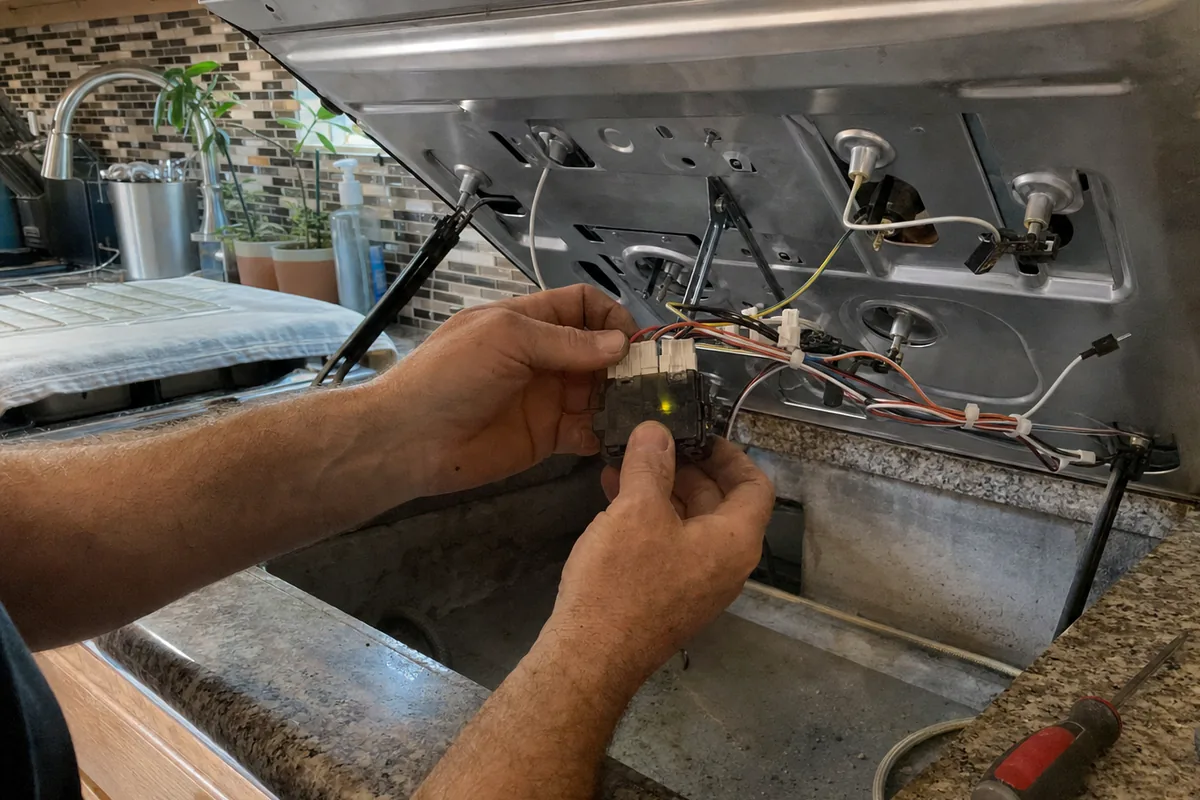
What people describe when they call
- A pan that always worked is suddenly not recognised by the zone
- A zone runs for a few minutes at high power and then drops out on its own
- The cooling fan under the cooktop runs loudly or runs long after cooking
- The glass surface has a chip or a hairline crack near an edge
- The whole cooktop goes dead while the oven underneath still works
- The oven half heats unevenly or takes far longer than it used to
What the visit involves
- Test the cooktop with a known-good ferrous pan before anything else is suspected
- Check that the cooling air path under and behind the range is genuinely open
- Measure supply voltage at the range and confirm the circuit is not shared
- Read cavity temperature in the oven against what the control is asking for
- Explain plainly when a cracked glass top makes a repair uneconomic
- Give you the price in writing before a part is ordered
Kitchen cooking appliances, and only those. Not home heating · air conditioning · heat pumps · HVAC ductwork · water heaters · refrigeration · dishwashers · laundry.
Induction cooking works by making the pan itself the heating element. A coil under the glass produces a changing magnetic field, the steel in the base of the pan resists that field, and the resistance turns into heat inside the metal. The glass never becomes the source of the heat. It only gets warm because the pan is sitting on it.
That single fact explains most of what goes wrong. If the pan cannot take part in the process, nothing happens at all, and the range is not broken. If the electronics that generate the field cannot get rid of their own waste heat, they protect themselves by shutting down, and the range is not broken then either. A genuine component failure is the third possibility, not the first.
When a pan stops being recognised
Start with the pan, even if it has worked for years. A magnet that will not stick firmly to the bottom of the pan means the zone cannot see it. That is the whole test, and it costs nothing.
Pans change over time in ways people do not notice. A base that has warped slightly, so that it rocks or so that only the rim touches the glass, presents much less metal to the coil and can fall below the detection threshold. A tri-ply pan whose bottom layer has begun to separate does the same. A pan that is simply smaller than the zone it is sitting on may never have been reliably detected and may only now be getting used on that zone.
If a known-good pan is recognised on every zone but one, the fault is in the range and we start looking at the coil and the module that drives it.
When a zone cuts out under load
The power electronics under an induction top produce real heat of their own, and they are cooled by a fan drawing air through the range and out again. Anything that interrupts that path causes the same symptom: full power for a few minutes, then a step down or a shutdown, then normal behaviour again once things cool.
In practice the interruptions are dull and physical. Dust and grease matted across an intake. A cabinet toe-kick that was closed up during a remodel. A range pushed the last half inch back against the wall when the floor was redone, closing the gap behind it. In a retrofitted opening, insulation packed into the side gaps by a well-meaning installer.
We check the air path before we condemn a module, because a module is an expensive part and a blocked vent is not a part at all.
The circuit
An induction range asks a great deal of its electrical supply, and it asks for it in short hard bursts. It needs a dedicated circuit of the right rating, and in an older Mandarin kitchen that circuit was frequently added rather than built in. We see the consequences of that regularly. A range that resets when the microwave starts, or a cooktop that behaves in the evening and misbehaves when the air handler is cycling, is describing a supply problem rather than an appliance problem.
Loose terminations at the range block are worth mentioning here too. Heat cycles loosen screws over years, a slightly loose connection heats, and a hot connection eventually discolours and fails. It is a five-minute check and it occasionally explains a fault that would otherwise cost a great deal to chase.
The oven underneath
The lower half of an induction range is a conventional electric oven, and it fails in conventional ways: an element that has partly opened, a sensor that has drifted a few degrees and is therefore telling a small consistent lie, a door seal that has taken a set and now leaks heat at one corner. Those are the same faults we would look for in any built-in oven, and they are diagnosed the same way, by measuring the cavity against the setpoint rather than trusting either one alone.
About cracked glass
A chip at the edge or a hairline crack across a zone is not something to work around. The glass is structural, it carries the weight of the pans, and it seals the electronics beneath it from spills. When a top is cracked we will say so plainly, tell you what a replacement costs, and let you decide without pressure. Sometimes the honest answer is that the repair is not worth it.
What does induction range repair repair cost in Mandarin?
The diagnostic is $80, flat, and it comes off the bill. After that, the repairs we are actually called out to in Mandarin land between $180 and $700, parts and labour together. The firm figure is written down after the diagnosis and before anything is ordered.
| What turned out to be wrong | Usual range |
|---|---|
| Diagnostic visit | $80 flat, credited |
| Door hinge, glass or seal | $190–$680 |
| Oven thermostat or temperature sensor | $180–$560 |
| Convection fan or motor | $270–$700 |
Ranges, not quotes. Two ovens with the same symptom can part company on the part number, and a retrofit opening can add an hour before a tool comes out of the bag. Nothing is ordered until the figure is in writing. The whole price page sets out how a job is priced.
Questions people ask about induction range repair
- How much does induction range repair repair cost in Mandarin?
- The visit and the diagnosis are $80 flat, and that comes off the bill if you go ahead. Door hinge, glass or seal then usually lands at $190–$680, parts and labour together. Oven thermostat or temperature sensor runs $180–$560. You get the figure in writing before a part is ordered.
- Is it worth repairing, or should the induction range repair be replaced?
- On a built-in appliance the honest answer is usually repair, because replacing one means matching a cabinet opening, a gas run, a duct and a circuit that were all built around the old machine. We say so when a repair stops making sense, and we say it before you spend.
- Will you have the part on the van?
- Often, because the van is stocked for one make. Igniters, sensors, seals and common elements ride with us. A control board or a cosmetic panel is ordered in, and the second visit to fit it carries no new diagnostic fee.
Where this comes up most
The parts of the service area where this fault turns up often enough to be worth a page of its own.
- Wolf ranges retrofitted into Mandarin kitchens drawn for something smallerMandarin · 32223
- Wolf ranges and built-in ovens in 1990s Julington Creek kitchensJulington Creek · 32223
- Wolf hoods in Bartram Park houses too tight to give them airBartram Park · 32258
Notes on this
Longer reading on the same faults, written in plain words.
- Storms and control boardsA board almost never dies from a direct hit. It dies from the smaller events either side of one, and the failure often arrives days after the storm that caused it.
- Fitting a 48-inch range in an old kitchenMost Mandarin kitchens were drawn around a thirty-inch range. Putting a forty-eight inch one in is four separate jobs, and the cabinet is only the first of them.
What owners said about induction range repair
4.6 out of 5 from 75 published reviews
After a limb took our power out the top would light up but no zone would heat. He checked the incoming supply first, then found the filter board had taken the hit. He replaced it and stayed to run every zone with a pan of water on it.
Simone V.
One zone read every pan as if nothing were on it. He tested the other three, changed the sensing coil under the bad one, and left the whole top working the way it is meant to.
Bertram F.
Two of the induction zones would run for a minute and then shut down with a fan roaring underneath. He lifted the top, cleared a mat of dust off the cooling intake and changed a failed fan. Both zones have held full power ever since.
Nadia F.
Tell us what the range is doing
Describe the symptom in your own words. If it is something you can put right in ten minutes at the panel, we will say so on the phone and there is nothing to pay.
A flat $80 covers the visit and the diagnosis, and it comes off the bill if you go ahead with the repair.
You get the price in writing before any part is ordered or any tool comes out of the bag.
Labour is warranted for 90 days and parts for 365 days, and the parts are genuine OEM.
Monday to Friday, 8:00am to 6:00pm. Saturday, 9:00am to 4:00pm. Closed Sunday.