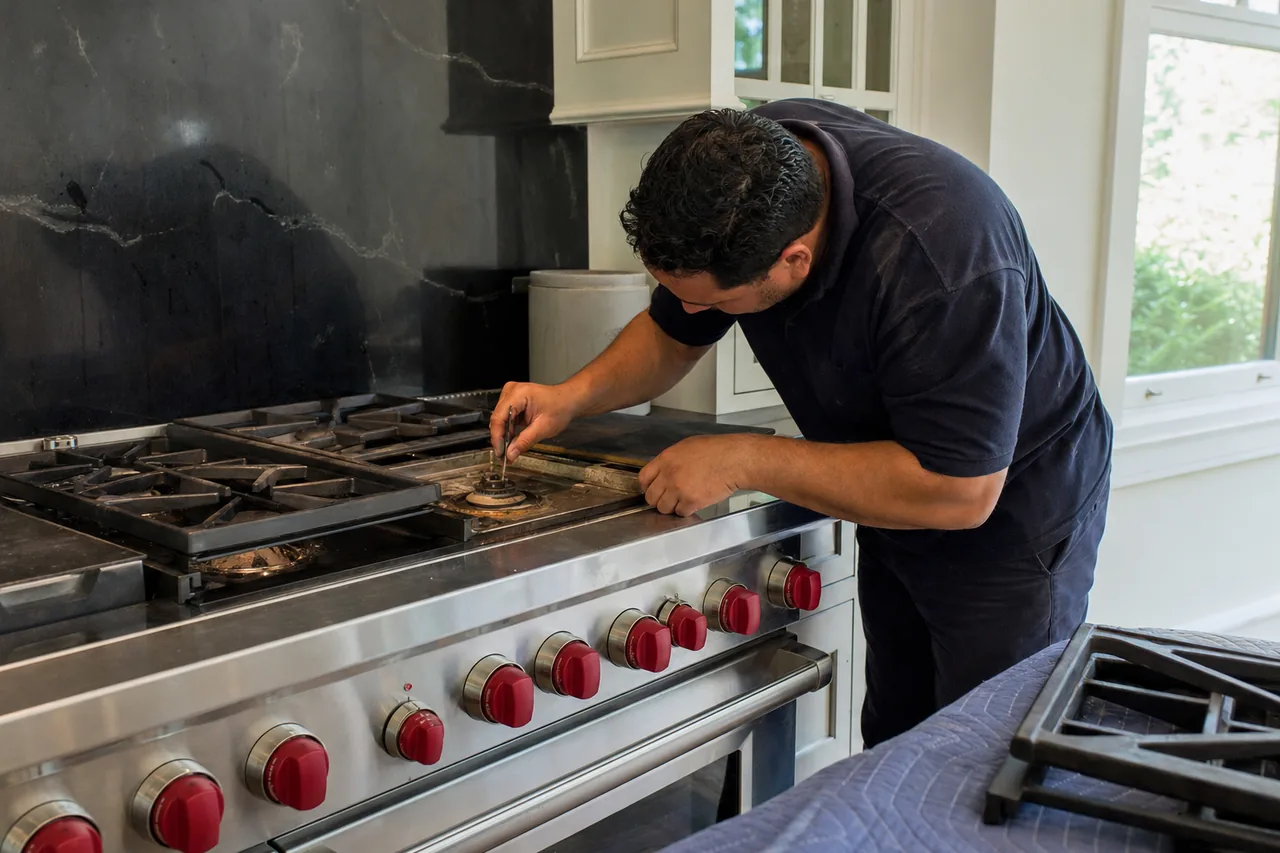
Wolf range replacement grates come through Wolf’s own parts channel, and the dependable way to get the right ones is to order by the model and serial number printed on your range. They are not universal: a sealed-burner GR range, an older open-burner R Series and a dual fuel DF top with a griddle each take different castings, so a generic hardware-aisle grate will sit wrong over the flames. A cracked grate, chipped enamel or a lost grate pad is a parts order, not a reason to give up on the range.
Why one grate will not fit every Wolf
Wolf changed its grates when it changed its burners. A current GR gas range has sealed burners with one grate bridging each pair, while the older R Series used open burners, a grate per burner, and a black light toggle where the GR has a stainless push button. That switch tells you which you own in a second.
Layout matters as much as width. Look for a trailing C (charbroiler), F (French top), G (griddle) or DG (two griddles) in the model number: each one takes space that would otherwise hold burner grates. A casting from another layout can look close yet leave its fingers off center, so pans wobble and the flame climbs the side of the pot.
Find the tag before you order
With the oven door swung open on a DF or GR range, the tag sits low on the control panel, at its right-hand end. SRT rangetops use the matching spot on their own panel. Older R Series ranges and RT Series rangetops keep it inside the burner box on its left side wall, under the pan of the left-hand burners, so lift that grate and pan first.
Photograph the tag rather than copying it, because one wrong digit ships the wrong part. The plate also says whether the range burns natural gas (NG or NAT) or propane (LP), worth having if burner parts join the order.
What wears on a grate, and what you can check
| What you notice | Usual reason | Owner check | Call us when |
|---|---|---|---|
| Grate rocks or rattles | A flattened or missing pad, or a grate in the wrong spot | Swap it with its neighbor and inspect each foot | It rocks in every position, so the pan beneath may be bent |
| Chipped edges | Knocks from heavy pans or the sink | Look for bare iron turning orange | Rarely; replace the grate when it bothers you |
| Crack across a finger or rail | Thermal shock, such as a hot grate dropped into cold water | Run a fingernail along the line | Stop using it and order a new grate |
| Uneven flame under a sound grate | Burner cap off its seat, or wet ports | Reseat the cap and let it dry | It still clicks or burns yellow |
Clean grates once they are cool, with warm soapy water and a soft brush rather than abrasive pads, and dry them fully before refitting. In a humid Mandarin kitchen near the St. Johns River, bare iron at a chip rusts within days if a grate goes back damp.
When the grate is fine and the burner is not
Lifting a grate often reveals the real fault. A GR dual-stacked burner is one assembly, its simmer flame running from a second tier on the cap, so a crooked cap gives a ragged flame or a burner that clicks without catching. The rear left burner is the small one at 9,200 Btu and the rest run at 15,000 Btu, so that corner always looks gentler.
If reseating and drying the cap changes nothing, book a visit instead of a part. Our diagnostic is $80; an igniter or spark module typically falls in the $200–$510 range and burner valve or orifice service in the $220–$700 range, with the firm figure after diagnosis. See our gas range repair page.
Where grates sit in the repair or replace sum
A grate never tips the decision by itself. What does is the range’s age, which part failed, how often that fault has returned, and what pulling out a built-in really involves. A worn grate on a sound range sits at the easy end; a control board failing again and again on an aging range sits at the other.
Replacement is more than a purchase. A replacement unit typically runs $5,200–$16,500, and the old range must be slid out, disconnected and swapped for one that is leveled and anchored. Wolf says anti-tip devices should always be fitted, and on current dual fuel and induction ranges the kit is part 829936. Our repair or replace page sets out the full sum.
If a part is claimed under Wolf’s limited five-year coverage while you use service outside Wolf’s network, it has to come from Wolf, which will not reimburse parts bought from other sources, so check before you buy.
Check the recall while the tag is out
Dual fuel ranges with an infrared griddle, such as DF36450G/S/P, fall under recall 25-034 when the serial number sits between 18517201 and 18868311 or between 10006001 and 10006009. Spills can short the range and switch the griddle on without warning. If yours matches, stop using it and contact Wolf to book the repair in your home.