Repair
Wolf steam ovens in Mandarin that say the reservoir is empty
A steam oven boils water and then lets it stand, so it fails in ways a dry oven never does — reservoir sensors, narrow passages, drains and gaskets that seal against moisture as well as heat.
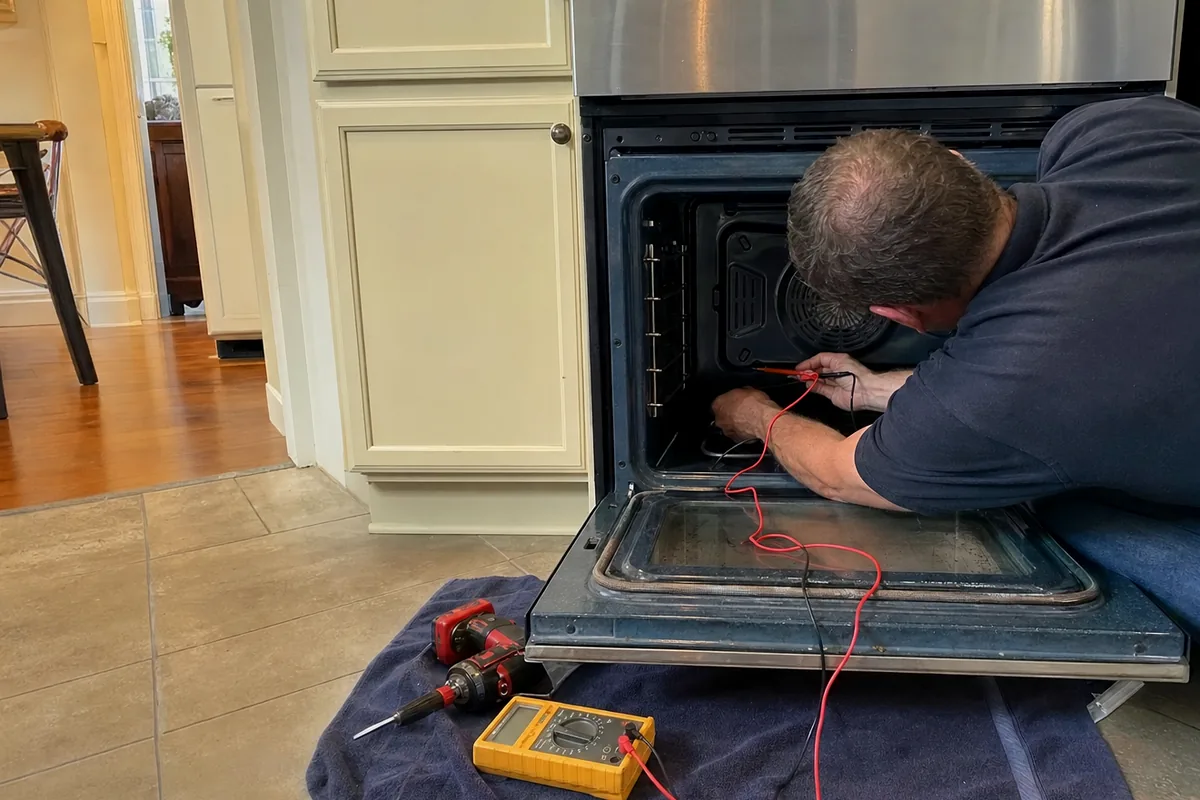
What people describe when they call
- The oven says the reservoir is empty when it has just been filled
- Steam takes much longer to build than it used to
- There is white chalky residue in the cavity or around the steam outlet
- Water is left standing in the bottom of the cavity after a cycle
- The descale reminder keeps appearing after a descale has been run
- The door glass fogs and stays fogged well after cooking has finished
What the visit involves
- Look first at the reservoir seat and its sensor before suspecting anything expensive
- Inspect the boiler and the fill path rather than assuming what has happened to them
- Run a full maintenance cycle properly and confirm what changes afterwards
- Check the drain path and the cavity gasket while the oven is warm
- Work out whether the appliance can come forward where it stands before we book the labour
- Give you the price in writing before a part is ordered
Kitchen cooking appliances, and only those. Not home heating · air conditioning · heat pumps · HVAC ductwork · water heaters · refrigeration · dishwashers · laundry.
A convection steam oven is two appliances sharing a cavity. One of them is a conventional fan oven and behaves like one. The other is a small boiler with a water path, a drain and a set of sensors watching both, and it is that half that generates most of the calls.
That is worth knowing before you ring, because the symptom you are describing usually belongs clearly to one half or the other, and it decides what we bring.
What we check, and in what order
We start with the cheap, common and reversible, because a surprising share of these calls end there and nobody should pay for a part they did not need.
First the reservoir and its seat. The oven cannot see water; it sees a sensor telling it that a reservoir is present and full. A reservoir that has not been pushed fully home, a seat with a spill dried in it, or a fouled sensor will all produce the same complaint of an empty tank that is plainly not empty.
Second, the fill path from that reservoir to the boiler, because a passage that has narrowed delivers water slowly, and a control watching for water to arrive within a set time concludes that something is wrong when it does not.
Third, the boiler itself and how long it is taking to make steam.
Fourth, the drain and the cavity, warm, because a drain that has partly closed leaves standing water that people describe as a seal fault.
Only then the electrical parts — fans, sensors, the control — because they are the expensive suspects and they are the least likely culprits on this particular appliance.
Where the deposit comes from
Everything that boils water leaves its minerals behind: the water goes off as steam and the calcium and magnesium do not. They settle on the hottest surface available, which is the boiler element, and they slowly line passages that were sized for clean water. A coated element has to work longer to put the same energy into the water, which is why the first symptom is almost always a delay rather than a failure.
JEA publishes tap water hardness by ZIP code, and for 32223 the figure is 254 parts per million, about 15 grains per gallon. That is hard enough for maintenance to be a scheduled item and mild enough that nothing appears wrong for the first two or three years.
The maintenance routine built into the appliance works well on fresh deposit, which is soft and porous, and poorly on old deposit, which years of thermal cycling turn into a hard layer. A reminder that returns immediately after the routine has been run is not a fault in the reminder — it is the appliance reporting accurately that the routine did not achieve what it is meant to achieve, and at that point the fix is mechanical or it is a part.
Doors, glass and gaskets
A steam oven door works harder than a dry oven door. It is sealing against moisture as well as heat, and the gasket has to stay compliant through thousands of wet heat cycles. When it hardens or takes a set, steam escapes at a corner, the glass fogs, and the fog stays long after cooking has finished because the pane is no longer being kept above the dew point on that side.
People usually report the fog rather than the leak, and it is a useful symptom: it tells us roughly where to look before we have taken anything apart. Feel around the closed door of a hot oven with the back of your hand and tell us which corner is warm and damp. It is the single most helpful sentence you can give us on this appliance.
Hinges matter here for the same reason they matter on a conventional oven. A weakened hinge lets the door sit a fraction proud at the top while still latching cleanly at the bottom, and the gap it opens is small enough to look like nothing.
It is a built-in before it is an oven
Nothing behind a steam oven can be reached until the appliance has come forward out of its cabinet, and that is a planned part of the job rather than a formality. These are heavy, they are usually mounted at eye level, and the opening they sit in was built to a specification that may or may not have been followed.
Depending on how the appliance was specified, it either draws from a plumbed supply line or from a reservoir that gets filled by hand. A plumbed one has a shutoff somewhere, and finding it before the job starts is worth five minutes of anybody’s morning. Where the appliance is stacked with another in a tall cabinet, the order things come out in is decided by the joinery rather than by us.
We work all of that out on the phone where we can, because the alternative is a technician standing in a kitchen deciding whether to take a countertop edge off while a customer watches.
What does convection steam oven repair repair cost in Mandarin?
The diagnostic is $80, flat, and it comes off the bill. After that, the repairs we are actually called out to in Mandarin land between $180 and $700, parts and labour together. The firm figure is written down after the diagnosis and before anything is ordered.
| What turned out to be wrong | Usual range |
|---|---|
| Diagnostic visit | $80 flat, credited |
| Convection fan or motor | $270–$700 |
| Door hinge, glass or seal | $190–$680 |
| Oven thermostat or temperature sensor | $180–$560 |
Ranges, not quotes. Two ovens with the same symptom can part company on the part number, and a retrofit opening can add an hour before a tool comes out of the bag. Nothing is ordered until the figure is in writing. The whole price page sets out how a job is priced.
Questions people ask about convection steam oven repair
- How much does convection steam oven repair repair cost in Mandarin?
- The visit and the diagnosis are $80 flat, and that comes off the bill if you go ahead. Convection fan or motor then usually lands at $270–$700, parts and labour together. Door hinge, glass or seal runs $190–$680. You get the figure in writing before a part is ordered.
- Is it worth repairing, or should the convection steam oven repair be replaced?
- On a built-in appliance the honest answer is usually repair, because replacing one means matching a cabinet opening, a gas run, a duct and a circuit that were all built around the old machine. We say so when a repair stops making sense, and we say it before you spend.
- What if the fault will not show itself while you are here?
- Some faults only appear cold, or only after two hours of baking. If we cannot reach a diagnosis on the first visit we say what the next step is and what it costs before we take it, rather than guessing at a part and charging you for the guess.
Where this comes up most
The parts of the service area where this fault turns up often enough to be worth a page of its own.
- Wolf ranges retrofitted into Mandarin kitchens drawn for something smallerMandarin · 32223
- Wolf wall ovens in Beauclerc, sitting in cabinetry that predates themBeauclerc · 32257
- Wolf hoods in Bartram Park houses too tight to give them airBartram Park · 32258
Notes on this
Longer reading on the same faults, written in plain words.
- Circuitry errors on Wolf ovensA circuitry message points behind the control panel, not at the heating parts. What sets it off, the one reset worth trying, the look-alike messages that are not faults, and when a meter has to settle it.
- An oven that runs coldThere are only two ways an oven can run cold. It is making less heat than it should, or it is losing heat faster than it should, and telling them apart is most of the job.
- Parts, serial numbers and waitingThe most useful photograph you can send us is not the fault. It is the rating plate, because the model and serial on it decide which version of a part the appliance takes and whether it is on the van already.
What owners said about convection steam oven repair
4.6 out of 5 from 75 published reviews
Booked in for a steam oven that would not hold its temperature. The diagnosis was right and the part cured it, though the wait for that part ran longer than either of us wanted it to.
Douglas E.
The steam oven kept ending a cycle early with a fault code I could not clear. He read it properly, changed the sensor behind it, and ran two cycles back to back before calling it done.
Josiah W.
The seal around the steam oven door had gone hard and let a plume out along the top edge. He fitted a new gasket and adjusted the catch so the door pulls in square. The cabinet above it stays dry now.
Lenora W.
Tell us what the range is doing
Describe the symptom in your own words. If it is something you can put right in ten minutes at the panel, we will say so on the phone and there is nothing to pay.
A flat $80 covers the visit and the diagnosis, and it comes off the bill if you go ahead with the repair.
You get the price in writing before any part is ordered or any tool comes out of the bag.
Labour is warranted for 90 days and parts for 365 days, and the parts are genuine OEM.
Monday to Friday, 8:00am to 6:00pm. Saturday, 9:00am to 4:00pm. Closed Sunday.