Duval County · 32223
Wolf induction ranges in Loretto, and the long run back to the panel
The Loretto Road corridor east of San Jose Boulevard. Big lots, 1980s and 1990s houses, and kitchens that are a long run from the electrical panel.
What is true of Loretto and nowhere else
- Houses along the Loretto Road corridor are typically 1980s and 1990s builds on generous lots, which means the kitchen is often at the far end of the house from the electrical panel and a dedicated range circuit is a long and expensive run.
- Induction ranges turn up here more often than in older parts of Mandarin, and an induction top is power electronics under glass, so it is fussier about its supply and its cooling air than the gas range it replaced.
- Lots in this area are large and heavily planted, and the driveways are long, so getting a five-hundred-pound range in or out is a planned part of the job rather than something to work out on the day.
Streets and communities we work in
Loretto · Lake Mandarin · Julington Hills · Egrets Landing · Gates of Olde Mandarin
What we are not the people to ring in Loretto about
This is a kitchen trade: cooking appliances, built in. Home heating, air conditioning, heat pumps and the ducted systems that serve the rest of the house are somebody else's work, and we say so rather than take the call. In Loretto that means the range, the rangetop, the built-in oven and the hood over the cooking surface — and nothing beyond the kitchen. A cooker hood has a duct of its own, and that duct is the only one we ever open. It is not part of the heating and air-conditioning system, we do not work on that system, and a hood problem is never a reason to ring us about the rest of the house.
Not us, in Loretto or anywhere else: home heating · air conditioning · heat pumps · HVAC ductwork · water heaters · refrigeration · dishwashers · laundry.
Loretto is the corridor running east off San Jose Boulevard into the older interior of Mandarin, and the houses along it are mostly the generation that followed Beauclerc: 1980s and 1990s, two storeys as often as one, sitting on lots that are noticeably larger than anything being built today.
That combination produces a very specific set of service problems, and they are not the ones people expect.
The panel is a long way from the kitchen
On a large lot, a house spreads out. The garage and the electrical panel end up at one end and the kitchen at the other, and the run between them may be sixty or eighty feet through walls, over a ceiling, or under a slab that nobody wants to open.
When these houses were built, the kitchen needed one modest circuit for a range and that was the end of it. Adding a proper dedicated circuit for a large induction range or a separate wall oven now means paying for that whole distance in copper and labour, and the temptation to avoid it is understandable.
The avoidance shows up in our work constantly. A range fed from a circuit it shares with something else will behave impeccably most of the time and then misbehave in a pattern. It resets when the air handler starts. It drops out in the evening when the kitchen is busiest. It runs perfectly on a cool weekday and strangely on a hot Sunday.
Those are supply symptoms, not appliance symptoms, and no part we could fit would cure them. We would rather find that on the first visit and tell you straight than replace a control board that was never at fault.
Induction is a different machine underneath
A fair number of the ranges we see along this corridor are induction, usually put in during a remodel to replace something gas. From the kitchen it looks like a simpler appliance. Underneath it is the opposite: a set of coils driven by power electronics, sitting directly under a glass top, with their own cooling fans and their own idea of how much air they need.
Three things follow from that, and all three change how a visit goes.
First, the supply matters more than it did. Power electronics are less tolerant of a supply that sags and recovers than a gas valve and an igniter ever were, so on a call about an induction top behaving oddly we look at what it is being fed before we look at what it is doing.
Second, the top itself is the service access and it is glass. Anything under it is reached by going through it, which means the appliance comes forward, the top comes off, and the job is slower and more careful than the equivalent on a gas range. Worth knowing when we quote the labour.
Third, those cooling fans have to breathe. An induction top installed over a tight drawer stack or boxed into cabinetry without the ventilation gap the manufacturer asks for will run hot, and a hot induction top protects itself by backing off the power or shutting down a zone. Owners describe that as zones that “give up” during a long cook. Nothing has failed. The appliance is doing what it is designed to do, and the fix is in the cabinetry rather than the electronics.
Getting the appliance in and out
Large lots come with long driveways, mature planting, and side gates that were sized for a lawnmower. A forty-eight inch range weighs the better part of five hundred pounds crated, and moving one is not something to improvise at nine in the morning with a customer standing in the doorway.
When a job is going to involve pulling a range out, we talk about the path first: where the van can get to, what the surface is like, whether there is a step, whether a door has to come off its hinges. It sounds fussy. It is the difference between a clean morning and a damaged floor.
What actually fails here
Because the houses are newer than Beauclerc’s, more kitchens were built with the appliance in mind, and there are fewer of the crude retrofit problems. What we see instead is honest wear on appliances that are now fifteen or twenty years old: oven door seals that have hardened and taken a set, hinges that have weakened enough to open a gap at the top of the door, temperature sensors that have drifted a few degrees and are quietly telling the control the wrong thing, convection fan bearings that have started to complain.
Those are the good repairs. They have a clear cause, a clear part, and a clear result, and the appliance genuinely goes back to how it was.
What does a repair in Loretto cost?
The diagnostic is $80, flat, and it comes off the bill. After that, the repairs we are actually called out to in Mandarin land between $180 and $700, parts and labour together. The firm figure is written down after the diagnosis and before anything is ordered.
| What turned out to be wrong | Usual range |
|---|---|
| Diagnostic visit | $80 flat, credited |
| Igniter or spark module replacement | $200–$510 |
| Burner valve or orifice service | $220–$700 |
| Oven thermostat or temperature sensor | $180–$560 |
| Convection fan or motor | $270–$700 |
Ranges, not quotes. Two ovens with the same symptom can part company on the part number, and a retrofit opening can add an hour before a tool comes out of the bag. Nothing is ordered until the figure is in writing. The whole price page sets out how a job is priced.
Questions from Loretto kitchens
- Do you cover Loretto?
- Yes. Mandarin, Jacksonville is home ground and Loretto (32223) is inside the 25 miles we work. Monday to Friday, 8:00am to 6:00pm. Saturday, 9:00am to 4:00pm. Closed Sunday. If you are further out than that we say so on the phone instead of taking the booking and sorting it out later.
- What does a repair in Loretto cost?
- The visit and the diagnosis are $80 flat, and that comes off the bill if you go ahead. Igniter or spark module replacement then usually lands at $200–$510, parts and labour together. Burner valve or orifice service runs $220–$700. You get the figure in writing before a part is ordered.
- What if the fault will not show itself while you are here?
- Some faults only appear cold, or only after two hours of baking. If we cannot reach a diagnosis on the first visit we say what the next step is and what it costs before we take it, rather than guessing at a part and charging you for the guess.
What we are usually called out to in Loretto
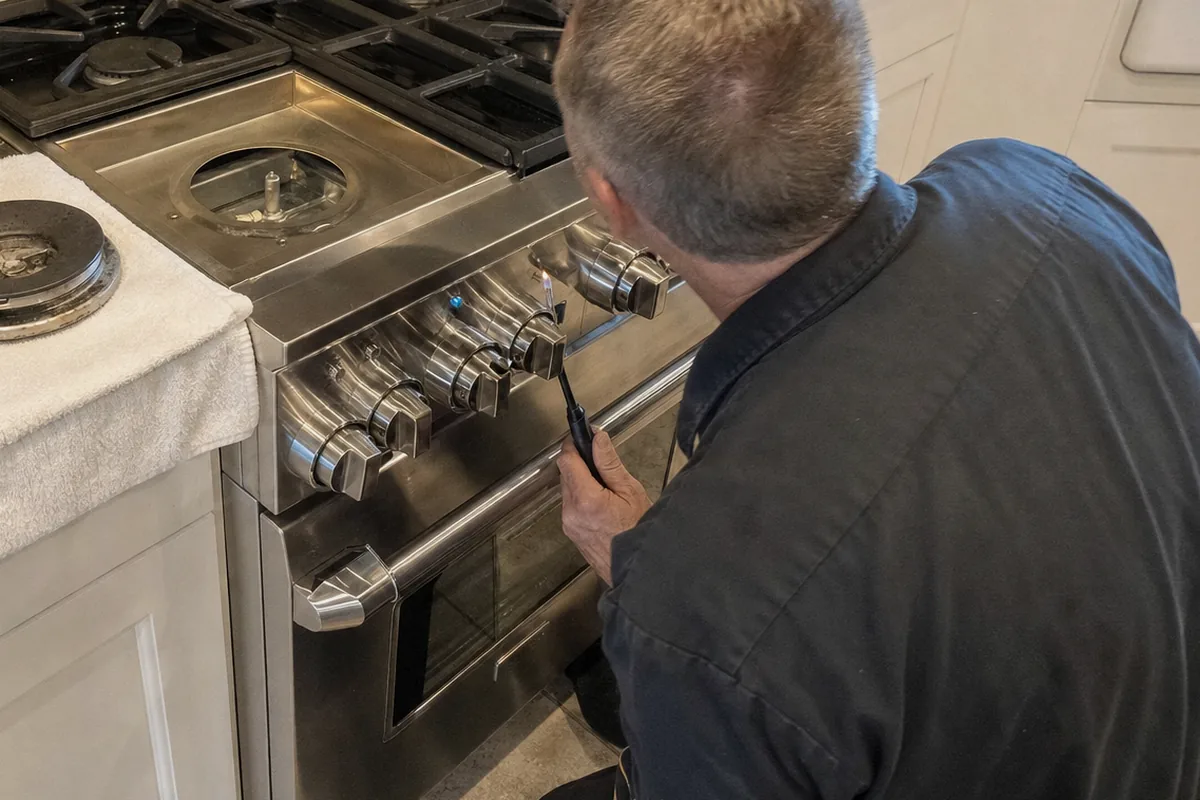
- Wolf gas range igniters in Mandarin that glow without ever lighting the burnerAn all-gas range puts a flame in the oven as well as on the top, which means the oven has a safety valve, and that valve is behind most of the slow-oven calls we take.
- Wolf rangetop burners in Mandarin that click and will not lightA rangetop drops into the counter with cabinetry underneath, so everything that fails is within arm's reach once the grates and burner bowls come off.
- Wolf cooker hoods in Mandarin that run but clear almost nothingA hood only does its job if the air it collects actually leaves the house, so half of what looks like a hood fault turns out to be a duct fault instead.
Reading that applies here
Streets nearby
- Mandarin32223
- Julington Creek32223
- Mandarin Road32223
What Loretto owners said
4.6 out of 5 from 75 published reviews
An error came up any time two zones ran together. He cleaned the cooling path and replaced the fan underneath, which he showed me was choked with dust off the floor vent beside it.
Clifton N.
The blower had become loud enough that we had stopped using the hood at all. He replaced the worn wheel and the mounts with it, and it is quiet again on the lower speeds.
Verna L.
Two of the induction zones would run for a minute and then shut down with a fan roaring underneath. He lifted the top, cleared a mat of dust off the cooling intake and changed a failed fan. Both zones have held full power ever since.
Nadia F.
Tell us what the range is doing
Describe the symptom in your own words. If it is something you can put right in ten minutes at the panel, we will say so on the phone and there is nothing to pay.
A flat $80 covers the visit and the diagnosis, and it comes off the bill if you go ahead with the repair.
You get the price in writing before any part is ordered or any tool comes out of the bag.
Labour is warranted for 90 days and parts for 365 days, and the parts are genuine OEM.
Monday to Friday, 8:00am to 6:00pm. Saturday, 9:00am to 4:00pm. Closed Sunday.